Inclave Review Australia: Login, Trust and Operator Checks
 Available in AU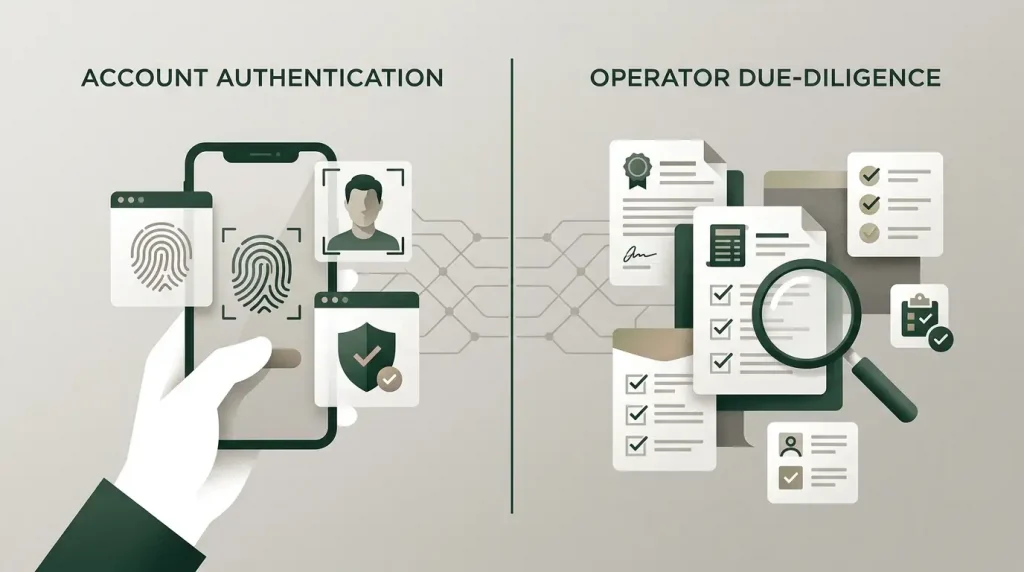
Evidence-led review
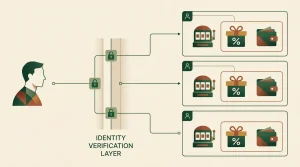
Inclave should be reviewed as a login and identity layer, not as the casino that controls gambling activity. Current integration pages describe shared account access, biometric login on compatible devices and use across desktop and mobile browsers. By contrast, connected casinos control their own games, bonuses, balances, cashier, withdrawals and additional KYC. That distinction matters when judging complaints: a login-access problem may relate to Inclave, while a payout delay or bonus dispute normally needs to be checked against the named casino operator. For Australian readers, the same separation applies to licensing. A current ACMA register check shows no Inclave entry, so Inclave should not be presented as an Australian licensed gambling provider.
Table of Contents
- The central finding: review two different layers
- What this Inclave review can verify
- What Inclave does not control
- Complaint attribution: who should own which problem?
- Australian trust check: do not treat Inclave as the gambling licence holder
- A practical trust checklist for an Inclave-connected casino
- How to read “Inclave scam” and “is Inclave safe” searches
- KYC, responsible gambling and account controls need scope labels
- Evidence standards used for this review
- Current sources used for the Inclave trust check
- How to separate Inclave login quality from a casino’s reputation
- Inclave Login: How One Account Works Across Casino Sites
The central finding: review two different layers
The most important review test is attribution. Inclave can make sign-in more consistent across supported casinos, but it does not turn those casinos into one operator. The login layer can be assessed for account access, authentication options and device compatibility. The casino layer must be assessed separately for licensing, payment handling, withdrawal decisions, bonus enforcement, game availability, customer support and operator-specific verification. Combining those two layers produces misleading conclusions.
What this Inclave review can verify
Current casino integration pages describe Inclave as an identity-management service used to simplify access to supported accounts. They describe facial or fingerprint authentication on compatible devices and cross-device use across desktop and mobile browsers. The broader fact base also supports a shared-login model in which one Inclave account can be used across participating casino brands.
These are meaningful product attributes, but they should be stated narrowly. Biometric login does not mean every device must use biometrics, and cross-device compatibility does not prove that every browser, casino implementation or account state will behave identically. The useful conclusion is that Inclave provides a reusable authentication layer with biometric support on compatible hardware, not that it guarantees a frictionless experience in every circumstance.
For the underlying model, see what Inclave is. For the sign-in flow and its boundaries, use the Inclave login.
What Inclave does not control
The strongest protection against a misleading review is to keep casino economics outside the Inclave column. Each connected casino controls its own games, promotions, player balance, cashier and withdrawal processing. Deposits and withdrawals are therefore not handled through one universal Inclave wallet. Additional casino-level KYC can also apply after a user signs in through Inclave.
This means there is no sound basis for publishing a single “Inclave payout time”, “Inclave withdrawal limit”, “Inclave bonus” or universal Inclave document checklist. Those details belong to the named casino operator and must be checked against that operator’s current official terms or cashier. A shared login can reduce repeated account-entry work, but it does not standardise every commercial or compliance rule behind the casinos that use it.
Complaint attribution: who should own which problem?
Public reviews often use “Inclave casino” as a convenient label. That wording can blur responsibility when a complaint is really about a specific casino. A better method is to classify the event before deciding what it says about Inclave.
| Issue reported | First entity to investigate | Reason |
|---|---|---|
| Cannot sign in through the shared Inclave flow | Inclave login layer, then the casino if account status is involved | The problem may concern authentication, credentials or the connection between the identity layer and the operator account. |
| Biometric login is unavailable on a device | Inclave/device compatibility | Biometric access is an authentication feature and depends on compatible hardware and implementation. |
| Withdrawal is delayed or rejected | Casino operator | The connected casino controls cashier functions, payout review and withdrawal terms. |
| Bonus terms were enforced unexpectedly | Casino operator | Bonuses and wagering conditions are operator-specific, not universal Inclave terms. |
| A game or provider is missing | Casino operator | Game availability belongs to the casino’s product offering. |
| Extra identity documents are requested | Casino operator unless the request clearly comes from Inclave | Connected casinos can impose their own KYC requirements and exact document lists should not be generalised. |
| Claim that a site is Australian licensed | Named gambling operator | The licence claim must be checked against the actual operator and the relevant Australian register. |
A complaint can still be useful evidence of a user’s experience, but it should not be converted automatically into a factual conclusion about the wrong entity. Before repeating an allegation, identify the casino, the legal operator, the event complained about and the source that can verify it.
Australian trust check: do not treat Inclave as the gambling licence holder
ACMA’s current register page states that an online wagering service must be on the register of licensed interactive gambling providers to operate in Australia. A same-session search of that register found no text match for “Inclave”. The appropriate conclusion is narrow: no Australian gambling licence was verified for Inclave itself. That is consistent with reviewing Inclave as an identity and login layer rather than presenting it as the gambling provider.
The absence of an Inclave entry does not answer the status of every casino that uses Inclave. For a named service, identify the actual operator and check that operator separately. The verify a casino operator shows how to match trading name, licence holder, URL and licensing authority. The broader Australian legal context explains why licensed wagering and prohibited online casino-style services should not be collapsed into one category.
A practical trust checklist for an Inclave-connected casino
Identify the counterparty
Find the casino brand and legal operator in the site’s current terms. Do not substitute Inclave for the gambling company.
Separate login from money
Treat account access as one system and deposits, balances, withdrawals and fees as operator-controlled functions.
Verify licence claims directly
If a service claims Australian wagering authority, check the live ACMA register rather than a review badge or copied licence statement.
Read current operator terms
Check the named casino’s own bonus, payment, withdrawal and KYC pages for the conditions that affect the account.
Attribute complaints carefully
Ask whether the allegation concerns login technology or the casino’s cashier, support, games, bonus rules or verification process.
Check responsible-gambling scope
Inclave account controls are described as including deposit-limit and self-exclusion or cooling-off tools, but operator and Australian regulatory tools can have different scope.
How to read “Inclave scam” and “is Inclave safe” searches
Those searches express a trust question, but they do not supply an answer by themselves. A “scam” label can refer to a failed withdrawal, a locked casino account, an unfamiliar login redirect, a support dispute or a security concern. Those events do not all belong to the same system. The review task is therefore to identify the event first and then test the relevant entity against evidence.
For the login layer, useful questions include whether the sign-in route is the expected Inclave flow, whether biometric or standard authentication behaves as documented, whether access works across compatible devices and whether the user can distinguish Inclave credentials from casino-specific account status. For the casino, the questions are different: who operates it, what licence is actually claimed, what the current payment and withdrawal rules say, and what KYC the operator can require.
This approach avoids two opposite mistakes. A positive experience with Inclave login does not prove that every connected casino has strong payout practices. A dispute with one connected casino also does not prove that Inclave itself processed the withdrawal or set the bonus rule.
KYC, responsible gambling and account controls need scope labels
Connected casinos may require their own KYC checks, so exact document requirements and processing times must be checked with the named operator. The shared identity layer should not be used to invent a universal verification checklist. That boundary is covered in more detail in the site’s KYC guide, while this review keeps the focus on attribution.
Independent current coverage describes Inclave account controls that include deposit limits and self-exclusion or cooling-off options across connected accounts. Those tools can be relevant to the identity layer, but they should not be confused with Australian schemes that apply to licensed wagering services or with a casino’s own responsible-gambling controls. The practical rule is to ask where the restriction is set and which accounts it actually covers.
Evidence standards used for this review
This page does not assign a numerical score because the site has not published a testing methodology that would make such a score reproducible. Instead, it checks discrete claims. Current connected-casino integration pages support the identity-management, biometric-login and cross-device claims. The operator-separation rule is supported by the project fact base and current industry evidence showing that casino bonuses, games, withdrawals, customer support and additional verification remain operator-specific.
For Australian licensing, the controlling check is the regulator’s live register rather than an affiliate review score. Public user reviews can identify complaint themes, but individual allegations are not repeated here as established facts without operator-specific evidence.
Current sources used for the Inclave trust check
Current integration evidence is available from Lucky Legends’ Inclave integration page and Slots of Vegas’ Inclave integration page, which describe identity management, biometric login and cross-device access. For Australian wagering licence claims, use the ACMA register of licensed interactive gambling providers. ACMA’s Interactive Gambling Act guidance provides the federal context for prohibited online gambling services.
Related context: Inclave casinos Australia.
How to separate Inclave login quality from a casino’s reputation
Judge Inclave on the functions it actually provides: shared account access, authentication options and compatibility across supported devices and casinos. Judge the gambling operator on the functions it controls: licence claims, games, bonuses, balances, cashier, withdrawals, customer support and additional KYC. When a review or complaint mixes those layers, split the claim into parts and verify each against the correct source. That method gives Australian readers a clearer basis for trust than a blanket “safe” or “scam” label attached to the entire Inclave ecosystem.