Inclave KYC and Verification: What the Casino Still Checks
 Available in AU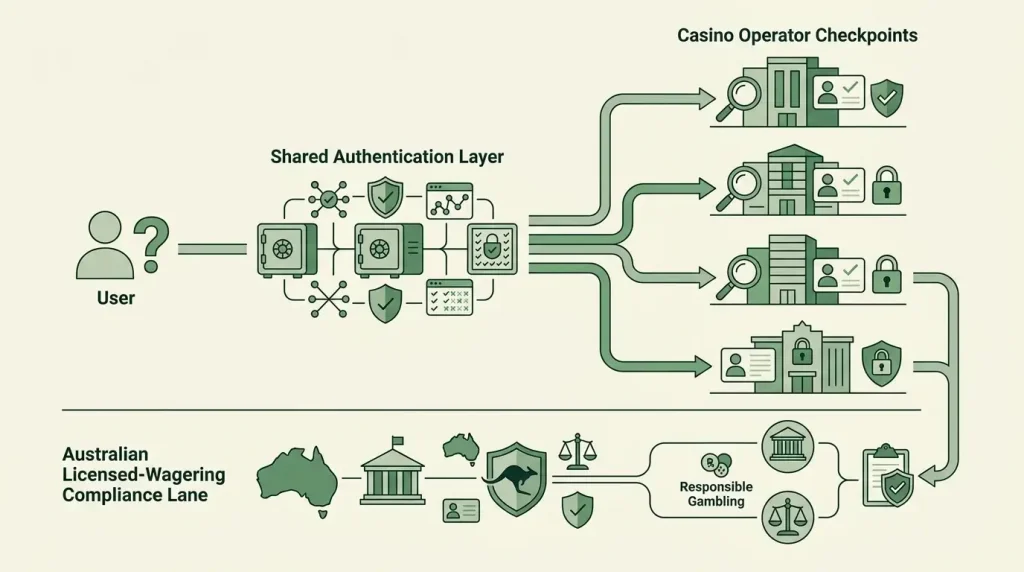
Identity and operator checks
An Inclave login does not create one universal KYC policy for every connected casino. Inclave provides the shared identity and authentication layer, while the gambling operator controls its own account checks, cashier and transaction processes. Connected casinos can therefore apply their own verification requirements even when the same Inclave identity is used for sign-in. In Australia, customer pre-verification is a specific requirement for licensed wagering providers: a new customer’s identity must be verified before that customer can place a bet. That rule does not turn an offshore online casino into an Australian licensed wagering service.
Table of Contents
- Inclave identity and casino KYC are not the same check
- Where the verification responsibility changes hands
- Why one shared identity does not become a network-wide KYC pass
- Australian pre-verification applies to licensed wagering accounts
- What to verify when a connected casino asks for KYC
- Do not borrow a document list from another Inclave casino
- Mobile biometrics do not remove later operator checks
- How KYC fits into operator due diligence in Australia
- Current references for Australian verification scope
- What Australia’s pre-verification rule does and does not establish
- Why casino verification still matters after an Inclave login
- Inclave Login: How One Account Works Across Casino Sites
Inclave identity and casino KYC are not the same check
Authentication answers whether the user can access the identity accepted by a supported casino. KYC answers a different set of operator questions about the gambling account and the operator’s compliance process. The same shared login can therefore lead to different verification requirements at different connected casinos.
This is why there is no safe Inclave-wide document checklist or universal verification time. Those specifics belong to the named operator’s current policy and should be checked there.
Where the verification responsibility changes hands
The cleanest way to understand the process is to separate the identity layer from the gambling relationship. Inclave can provide the login that a supported casino recognises. Once the user is inside that casino account, the operator remains responsible for the gambling products, balance, cashier, withdrawals and casino-level verification.
| Question | Inclave identity layer | Connected casino operator |
|---|---|---|
| Who handles shared sign-in? | Inclave provides the reusable authentication layer for supported brands. | The operator integrates that login into its own service. |
| Who controls games and bonuses? | Not Inclave. | The casino controls its own gambling products and promotion terms. |
| Who controls the player balance and cashier? | Not Inclave. | The casino controls its own balance, deposits and withdrawals. |
| Who sets casino-level KYC requirements? | There is no universal Inclave KYC policy for all connected casinos. | Requirements are operator-specific and should be taken from the operator’s current terms or verification process. |
| Does one successful login clear every connected casino? | No. | Another operator can still require its own account checks. |
Why one shared identity does not become a network-wide KYC pass
The phrase “one account” can easily be misunderstood. One Inclave identity can be recognised across supported brands, but that does not turn those brands into one regulated gambling business. Each casino remains a separate operator environment with its own account economics and compliance responsibilities.
That is also why a verification request from one connected casino should not be copied across the network. A document request, review stage or account restriction at Casino A is evidence about Casino A’s process. It does not establish the process used by Casino B simply because both accept the same Inclave login.
The same rule applies to withdrawals. Inclave does not process casino payouts. If verification is connected to a withdrawal or account review, the relevant evidence is the operator’s current cashier, verification or terms information rather than an Inclave-wide payout rule.
Australian pre-verification applies to licensed wagering accounts
Australia has a specific customer-verification rule for licensed wagering providers. The Department of Social Services states that a customer’s identity must be verified when a new account is registered and before the customer can place a bet. This is part of the National Consumer Protection Framework for Online Wagering and is regulated through Australian state and territory arrangements.
That rule needs a strict scope boundary. ACMA states that the Interactive Gambling Act prohibits providers from offering online casino services to people in Australia, while licensed online wagering operates under a different framework. The wagering pre-verification requirement therefore should not be used as evidence that an offshore casino-style service is licensed or authorised for Australian customers.
Scope check for Australian readers
“Identity verified before betting” is a requirement for Australian licensed wagering providers. It is not a general approval label for every gambling site that can be reached from Australia, and it is not an Inclave-specific KYC rule.
What to verify when a connected casino asks for KYC
Because the exact document list and timing cannot be universalised, the useful task is to verify the operator’s process rather than memorise a generic checklist.
Identify who is asking
Confirm that the request belongs to the actual casino operator or its official account environment, not to a copied message or unrelated third party.
Check the stated purpose
Read the operator’s current verification or account terms so you understand what part of the casino relationship the check addresses.
Check when the process applies
Do not assume another connected casino uses the same trigger or sequence. Use the named operator’s current wording.
Use the operator’s official channel
Submit sensitive account information only through the official method specified by the operator and review its privacy information before sending anything.
Separate login from compliance
A successful Inclave authentication confirms access to the shared identity, not completion of every casino-level verification step.
Verify the operator itself
Check the legal entity and regulatory position separately rather than treating the presence of Inclave as evidence about a gambling licence.
Do not borrow a document list from another Inclave casino
Generic KYC articles often list identity, address or payment evidence as if every operator follows one fixed sequence. That is exactly the shortcut to avoid here. The validated project facts establish that casino-level KYC is operator-specific, but they do not establish a universal Inclave document set or a universal processing time.
For a named casino, use its current official terms, verification page or logged-in account instructions. If those sources do not state a specific requirement, do not fill the gap with a list copied from another operator. That approach keeps authentication facts separate from unsourced compliance detail.
Mobile biometrics do not remove later operator checks
Facial or fingerprint login can make repeat access easier on compatible devices, but biometric authentication still belongs to the sign-in layer. It does not guarantee that a casino has completed every account, transaction or regulatory check that its own policies require.
The separate mobile biometric login explains the device side of Inclave access. For the full shared-login model, see the Inclave login.
How KYC fits into operator due diligence in Australia
KYC should be one item in a broader operator check, not a substitute for it. A site can ask for identity information without that request proving the site is an Australian licensed wagering provider. Conversely, Australian licensing and customer pre-verification are regulatory questions that should be checked against Australian sources rather than inferred from login technology.
The Australian verification rules explains the distinction between licensed wagering and prohibited online casino-style services. The verify the casino operator focuses on verifying the gambling operator itself. The Inclave Australia guide keeps those checks separate from the shared identity layer.
Current references for Australian verification scope
The Australian Government’s gambling reforms page states that customer identity must be verified on registration and before a bet for licensed wagering accounts. ACMA’s Interactive Gambling Act guidance separately identifies online casinos among services that providers are prohibited from offering to people in Australia.
What Australia’s pre-verification rule does and does not establish
The Department of Social Services states that providers covered by the Australian online wagering framework must verify a customer’s identity when a new account is registered and before the customer can place a bet. That is a useful regulatory benchmark for licensed wagering accounts, but it should not be stretched into a universal KYC rule for every offshore casino-style site that happens to use Inclave.
The rule establishes the timing of identity verification for the regulated wagering context. It does not create one Inclave-wide document list, one verification time or one withdrawal procedure. A connected casino can have its own compliance process, and a login service cannot substitute for the operator’s obligations or policies. This is why the named operator’s current terms remain the right place to check who requests information, how the request is delivered and what account action depends on completion.
For readers comparing several Inclave-connected sites, the most reliable approach is to keep the Australian wagering requirement in one column and the operator’s own published verification process in another. Similar wording should not be treated as proof that the systems are identical. The shared login may establish continuity of identity access, while the operator still decides what additional evidence is required for its gambling account.
Why casino verification still matters after an Inclave login
An Inclave login can establish access to a reusable identity, but it does not erase the separate relationship with each casino operator. For Australian readers, licensed wagering pre-verification has a defined regulatory scope and should not be projected onto offshore casino-style services. When a connected casino requests KYC, verify the request against that operator’s current official information instead of relying on a network-wide document list. Keeping authentication, operator KYC and Australian licensing as three separate questions produces a much clearer account-safety check.